
bleach, bleach, bleach.... (Due to the caustic nature of this chemical, the faithful and courageous are STRONGLY warned of the hazards! Suggested safety materials include - but are not limited to - latex gloves, a work apron, and eye protection. Remember to take care, to look out for those around you and their property, and be cognizant of applicable environmental concerns in your area when disposing of spent chemical.) On white paper, the transparent media we often use can give us beautiful, vibrant color. On black paper, transparent media are useless as they would disappear into the background. We either have to use media that is opaque (it covers up what is underneath) to even show up against the black, or we have to remove the black coloring of the paper in order to re-stain these now lighter areas with our dyes and pigments. Although the general mathematical relationship between 1) dark objects against a light background, and 2) light objects against a dark background might be the same in a comparison between two examples, as human beings we have a tendency to be more affected by a the latter. Light things seem to come forward out of the dark better than dark things do out of light. Hence, the popularity of the "velvet Elvis"...but we'll not go there. We can take out much of the black of black paper with bleach. It will probably not turn white - and some papers may not bleach at all! - but we could probably end up with an area much, much lighter than the original paper and, hence, more receptive to our colored stainings. Once we have re-introduced color into these lighter area, a white detailed print can be re-positioned over this image to make it virtually JUMP off the page at us. And since the white inks and paints that we use in this craft are usually water-based, the moisture in them will re-constitute the dyes/paints that we use to color in our main image. This means that what once was white ink that we put on our image will, in all probability, take on the color of the dye underneath. the white will become a pale, opaque version of the base color beneath it. We can then continue to add highlights as needed. Since stamps are just guidelines (I think I've said this before), these accents or highlights can be added by hand using a broad range of media: things like colored pencils, office correction fluid, other paints or inks and/or markers, etc. All we need to do is pay attention to a few issues of opacity and/or transparency. link to class schedule copyright © 2017 Fred B. Mullett |
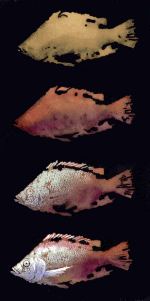
Click
the image above for a larger version of
this example and others.